
Many people feel confused when writing dates and numbers in English. A small ending can change whether a word looks correct or incorrect. The common mistake happens when people choose the wrong suffix for ordinal numbers. Understanding the simple rule behind these endings makes writing much easier.
The question of 22nd or 22th often appears in emails, invitations, school work, and professional documents. The correct form is easy to remember once you know the rule. Numbers ending in 2 usually take “nd,” so the correct spelling is 22nd. This guide explains the difference with simple examples.
22th or 22nd – Quick Answer
If you’re wondering whether 22th or 22nd is correct, the answer is simple. 22nd is the only correct form in Standard English. The spelling 22th is grammatically incorrect and isn’t dictionary accepted. Whether you’re writing dates, birthdays, anniversaries, emails, or business documents, always use 22nd. This grammar rule follows the standard ordinal number rules used in English grammar. Since 22 ends with the number 2, it takes the suffix “nd” instead of “th.” This rule applies in British English, American English, International English, and Global English, so you never need to change it based on where you live.
Quick Answer
- ✅ 22nd = Correct
- ❌ 22th = Incorrect
- Twenty-second is the correct word form.
- The last digit rule decides the correct number endings.
- Use 22nd in formal writing, professional writing, academic papers, and social media.
Conversation Examples
Person A: Is my birthday on June 22th?
Person B: Almost. It should be June 22nd.
Person A: Should I write “22th anniversary”?
Person B: No. Write 22nd anniversary instead.
Simple Rule
The easiest way to remember 22th or 22nd is to look at the last digit. In ordinal numbers, numbers ending in 1 usually take st, numbers ending in 2 take nd, numbers ending in 3 take rd, and most other numbers take th. That means 22nd is correct because 22 ends in 2. However, 11th, 12th, and 13th are special exceptions. Even though they end with 1, 2, and 3, they always use th. Once you learn this simple grammar rule, writing numbers becomes much easier in school assignments, academic writing, and everyday communication.
Ordinal Number Rules
- 1st = First
- 2nd = Second
- 3rd = Third
- 4th = Fourth
- 21st = Twenty-first
- 22nd = Twenty-second
- 23rd = Twenty-third
- 24th = Twenty-fourth
- 31st = Thirty-first
- 42nd = Forty-second
- 100th = One hundredth
Remember the Exceptions
- 11th
- 12th
- 13th
Conversation Example
Student: Why isn’t it 22th?
Teacher: Because numbers ending in 2 always use nd, except the number 12th.
The Origin of 22th or 22nd
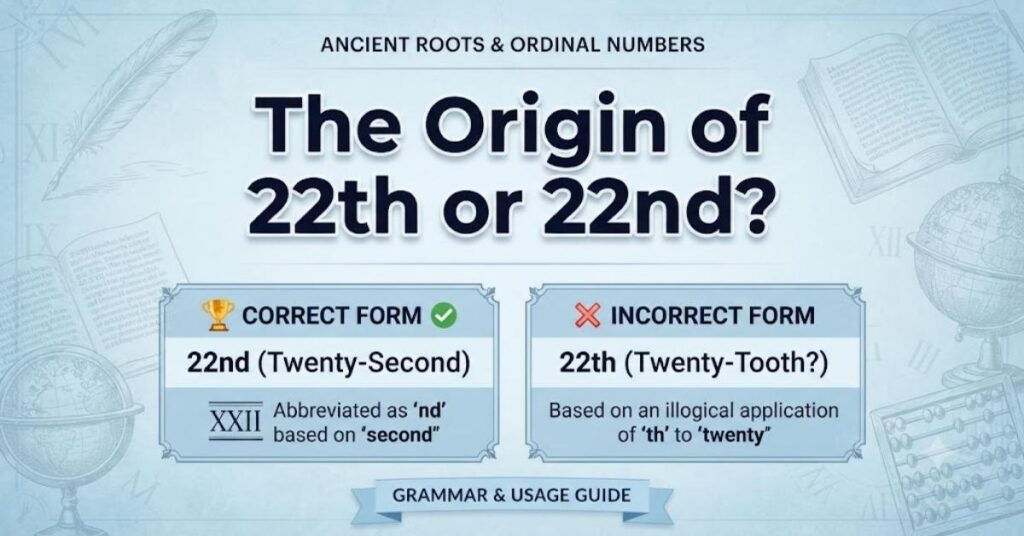
Understanding the history behind 22th or 22nd makes the rule easier to remember. English has used ordinal numbers for hundreds of years to show order, sequence, or number position. Words like first, second, and third eventually became the shorter forms 1st, 2nd, and 3rd. The ending “nd” in 22nd comes directly from the word second. Since twenty-second ends with second, it naturally keeps the same suffix. Many people write 22th because they notice that most numbers use th, such as 4th or 100th. However, the grammar rule has remained the same across Standard English, making 22nd the only correct choice.
How the Pattern Developed
| Number | Word Form | Correct Ordinal |
| 1 | First | 1st |
| 2 | Second | 2nd |
| 3 | Third | 3rd |
| 22 | Twenty-second | 22nd |
Conversation Example
Friend: Why does 22 use “nd”?
You: Because it comes from the word second, not from th.
British English vs American English Spelling
Many grammar rules change between British English and American English, but this isn’t one of them. Whether you’re writing for readers in the United States, United Kingdom, India, Pakistan, or Canada, the correct spelling is always 22nd. There are no regional differences for this rule. Standard English follows the same ordinal number rules around the world. That means you can confidently use 22nd in International English, Global English, business writing, academic papers, professional writing, and formal writing. No matter where your audience lives, they’ll expect to see 22nd instead of 22th.
Key Facts
- British English uses 22nd.
- American English uses 22nd.
- Global English uses 22nd.
- 22th is incorrect everywhere.
- The rule never changes by country.
Conversation Example
Writer: Do I need a different spelling for UK readers?
Editor: No. 22nd is correct in every English variety.
Comparison Table
| Form | British English | American English | Standard English |
| 22nd | ✅ Correct | ✅ Correct | ✅ Accepted |
| 22th | ❌ Incorrect | ❌ Incorrect | ❌ Not accepted |
Which Spelling Should You Use?
The answer is always 22nd. If you’re writing dates, sending emails, preparing invitations, completing school assignments, or creating business documents, choose 22nd every time. Using the correct ordinal number improves writing clarity and shows professionalism in writing. Both English learners and native speakers sometimes make this mistake because most numbers use the th ending. Recent Google Trends and search data show that many people search for 22th or 22nd, proving it’s a common grammar question. Learning the correct form now will help you avoid common mistakes and correct vs incorrect usage errors in the future.
Always Use 22nd For
- Dates
- Birthdays
- Anniversaries
- Invitations
- Emails
- Social media
- Academic writing
- Academic papers
- Business writing
- Business documents
- Formal writing
- Professional writing
Conversation Example
Employee: The meeting is on April 22th.
Manager: Please change it to April 22nd before sending it.
Common Mistakes with 22th or 22nd
Many people search for 22th or 22nd because they aren’t sure which spelling is correct. The answer is always 22nd. The spelling 22th doesn’t follow English grammar or standard ordinal number rules. This mistake appears in school assignments, emails, business documents, academic writing, and even social media posts. It happens because most ordinal numbers end with th, so people naturally assume every number should use the same suffix. Once you understand the last digit rule, you’ll avoid this error with confidence. Whether you write for readers in the United States, United Kingdom, India, Pakistan, or Canada, the correct form never changes.
Common Mistakes
- Writing 22th birthday instead of 22nd birthday.
- Typing January 22th in a date.
- Using 22th anniversary on invitations.
- Writing 22th floor in business writing.
- Forgetting the correct number endings.
Conversation Example
Friend: Is “22th” okay here?
You: No. It should always be 22nd.
Audience-Based Usage
The correct spelling for 22th or 22nd stays the same no matter who reads your writing. Whether your audience lives in the United States, United Kingdom, India, Pakistan, or Canada, everyone follows the same grammar rule. British English, American English, Standard English, and International English all use 22nd. That makes writing much easier because you don’t need different versions for different countries. Using the correct ordinal number also improves writing clarity and shows professionalism in writing. From formal writing to casual text messages, the correct choice remains the same every time.
Audience Guide
| Audience | Correct Form |
| United States | ✅ 22nd |
| United Kingdom | ✅ 22nd |
| India | ✅ 22nd |
| Pakistan | ✅ 22nd |
| Canada | ✅ 22nd |
| Global English | ✅ 22nd |
Conversation Example
Writer: Should I change it for UK readers?
Editor: No. Everyone uses 22nd.
Common Errors and Fixes
The easiest way to improve your writing is to spot common mistakes before you send or publish your work. Many English learners and even native speakers accidentally write 22th because they focus on the th ending used by many numbers. However, ordinal number rules say numbers ending in 2 take the nd suffix instead. A quick proofread can help you catch these mistakes before they appear in academic papers, emails, business documents, or professional writing. Learning these corrections once will save you from making the same mistake again.
| Incorrect | Correct |
| 22th birthday | 22nd birthday |
| January 22th | January 22nd |
| June 22th | June 22nd |
| 22th anniversary | 22nd anniversary |
| 22th floor | 22nd floor |
Conversation Example
Student: I wrote “22th anniversary.”
Teacher: Change it to 22nd anniversary.
Incorrect Example
Looking at incorrect examples helps you understand why 22th or 22nd causes confusion. The spelling 22th doesn’t follow English grammar because the last digit rule requires numbers ending in 2 to use nd. This mistake often appears in dates, birthdays, anniversaries, invitations, and school assignments. Although many people type it, dictionary usage doesn’t recognize 22th as a correct ordinal number. If you see this spelling, treat it as an error and replace it immediately.
Incorrect Sentences
- ❌ The meeting is on July 22th.
- ❌ Happy 22th birthday!
- ❌ Our 22th anniversary is next week.
- ❌ Please arrive on May 22th.
Conversation Example
Employee: I’ll schedule it for August 22th.
Manager: Please change that to August 22nd.
Correct Example
Using 22nd shows that you understand ordinal number rules and proper English grammar. The correct form works in every type of writing, including academic writing, business writing, emails, formal writing, and social media. It also improves writing clarity because readers instantly recognize the correct number position. Whenever you’re writing the twenty-second day, floor, birthday, or anniversary, choose 22nd without hesitation.
Correct Sentences
- ✅ The conference begins on July 22nd.
- ✅ Happy 22nd birthday!
- ✅ We celebrated our 22nd anniversary.
- ✅ Her office is on the 22nd floor.
Conversation Example
Friend: Is June 22nd written correctly?
You: Yes. That’s the correct ordinal form.
Why the Mistake Happens
The confusion around 22th or 22nd comes from a simple pattern. Most ordinal numbers use the th suffix, including 4th, 100th, and many others. After seeing those examples, people assume every number follows the same rule. However, English grammar changes the ending based on the final digit. Numbers ending in 1, 2, and 3 usually take st, nd, and rd, while the special cases 11th, 12th, and 13th keep th. That’s why 22nd is correct. Recent Google Trends and search data show thousands of people search this topic because it’s a common grammar question.
Why People Get Confused
- Most numbers end with th.
- People forget the last digit rule.
- Exceptions make the pattern harder to remember.
- The mistake spreads through casual writing.
Conversation Example
Student: Why do I always type 22th?
Teacher: Because your brain copies the common th pattern.
Easy Rule for Ordinal Numbers
Learning ordinal number rules doesn’t have to feel difficult. A simple trick makes everything easier. Look at the last digit of the number before adding the correct suffix. Numbers ending in 1 usually take st, numbers ending in 2 take nd, numbers ending in 3 take rd, and every other ending normally takes th. This rule works for almost every ordinal number in English grammar. It helps you write dates, birthdays, anniversaries, and number positions correctly in both British English and American English. Once you remember this pattern, choosing between 22th or 22nd becomes effortless.
Ordinal Number Guide
- 1st → First
- 2nd → Second
- 3rd → Third
- 4th → Fourth
- 21st → Twenty-first
- 22nd → Twenty-second
- 23rd → Twenty-third
- 24th → Twenty-fourth
- 31st → Thirty-first
- 42nd → Forty-second
- 100th → One hundredth
Conversation Example
Child: How do I know which ending to use?
Parent: Check the last digit first.
Exceptions
Every grammar rule has a few surprises. The biggest exceptions in ordinal numbers are 11th, 12th, and 13th. Even though these numbers end in 1, 2, and 3, they don’t use st, nd, or rd. Instead, they always take the th suffix. These exceptions are important because many English learners make mistakes with them. Remembering this small group will help you write more accurately in academic papers, business documents, and professional writing. Once you know these exceptions, the rest of the grammar rule becomes much easier.
Exception List
- 11th
- 12th
- 13th
Conversation Example
Student: Should I write 12nd?
Teacher: No. It’s always 12th.
22th or 22nd in Everyday Examples
You’ll use 22nd more often than you might think. It appears in dates, birthdays, anniversaries, emails, invitations, social media, business documents, and formal writing. Choosing the correct form keeps your writing polished and easy to understand. It also shows attention to detail, which matters in professional writing and academic writing. Whether you’re sending a meeting invitation or posting a birthday message online, using 22nd instead of 22th makes your writing look more accurate and trustworthy.
Everyday Examples
- Email: Our meeting is on July 22nd.
- Birthday: Happy 22nd birthday!
- Invitation: Join us on August 22nd.
- Business document: Payment is due on September 22nd.
- School assignment: The report is due on October 22nd.
- Social media: Can’t wait for my 22nd birthday!
Conversation Example
Coworker: Is the meeting on May 22nd?
Manager: Yes. Please add May 22nd to the calendar.
Emails
Using the correct form of 22th or 22nd is important when you write emails. A small grammar mistake can make your message look rushed or unprofessional. Whether you’re scheduling a meeting, confirming an appointment, or sending a reminder, always use 22nd. This follows English grammar, ordinal number rules, and accepted dictionary usage. It also improves writing clarity, especially in business writing and professional writing. Readers notice these details, even if they don’t mention them. Taking a few extra seconds to check the date helps you create polished emails that leave a better impression. This rule applies in British English, American English, Standard English, and International English.
Email Examples
- Our meeting is on July 22nd.
- Please submit your report by August 22nd.
- The interview is scheduled for September 22nd.
- Your payment is due on October 22nd.
Conversation Example
Employee: Is the meeting on May 22th?
Manager: Please change it to May 22nd before sending the email.
News
News organizations follow strict style guides because accuracy matters. That’s why you’ll always see 22nd instead of 22th in headlines and articles. The correct ordinal number helps readers understand dates quickly and keeps reports consistent. Journalists use the same grammar rule whether they’re writing for the United States, United Kingdom, Canada, India, or Pakistan. If you write articles, blog posts, or press releases, follow the same standard. Using 22nd makes your content look more reliable and professional. It also matches accepted English grammar across every major news publication.
News Examples
- The event begins on July 22nd.
- The company announced results on March 22nd.
- Elections will take place on November 22nd.
- The festival opens on June 22nd.
Conversation Example
Reporter: Should I write “22th” in the headline?
Editor: No. Every news story should use 22nd.
Social Media
People often type quickly on social media, so grammar mistakes happen more often. Even so, using 22nd instead of 22th makes your posts look cleaner and more polished. Whether you’re celebrating a birthday, sharing an anniversary, or announcing an event, the correct ordinal number helps your message look trustworthy. Good grammar also supports professionalism in writing, especially for brands and businesses. While casual posts may contain mistakes, using the correct form shows attention to detail. The rule stays the same across Instagram, Facebook, X, TikTok, and LinkedIn because 22nd is correct in Global English.
Social Media Examples
- Happy 22nd birthday to me!
- Counting down to July 22nd!
- See you on August 22nd.
- Our sale starts September 22nd.
Conversation Example
Friend: Does “22th birthday” look right?
You: No. It should be 22nd birthday.
Formal Writing
Grammar matters even more in formal writing. Whether you’re preparing academic papers, business documents, legal letters, or official reports, you should always write 22nd. The incorrect spelling 22th can distract readers and reduce your credibility. Following the correct ordinal number rules improves writing clarity and demonstrates strong attention to detail. It also helps your work meet the standards expected in professional writing. Since this rule never changes between British English and American English, you can confidently use 22nd in every formal document.
Formal Writing Examples
- The agreement begins on July 22nd.
- The conference opens on August 22nd.
- The assignment is due September 22nd.
- The report was submitted on October 22nd.
Conversation Example
Student: Is “22th” acceptable in my paper?
Professor: No. Always write 22nd.
Invitations
Dates are one of the first things guests notice on an invitation. That’s why using 22nd instead of 22th is so important. Whether you’re inviting people to a wedding, birthday party, anniversary celebration, graduation, or business event, the correct ordinal number keeps your invitation clear and professional. A small grammar mistake can distract from an otherwise beautiful design. Following English grammar and the proper suffix ensures your invitations look polished. This rule applies to printed cards, digital invitations, and online event pages alike.
Invitation Examples
- Join us on July 22nd.
- Celebrate our 22nd anniversary.
- You’re invited on August 22nd.
- Save the date: September 22nd.
Conversation Example
Designer: Should I print “22th Anniversary”?
Client: No. Please use 22nd Anniversary.
22th or 22nd – Google Trends & Usage Data
Search interest in 22th or 22nd continues to grow because many people want to avoid simple grammar mistakes. According to Google Trends and related search data, users regularly search this topic before writing dates, emails, school assignments, academic writing, and business documents. The keyword receives attention from English learners and native speakers alike. Searches come from countries such as the United States, United Kingdom, India, Pakistan, and Canada. Most users want a quick answer, but they also want to understand the grammar rule behind the correct ordinal number. That makes this a valuable topic for anyone who writes in English.
Popular Search Topics
- 22th or 22nd
- Is 22th correct?
- How to write 22nd
- Ordinal number rules
- Twenty-second spelling
- Correct vs incorrect usage
- Common mistakes with ordinal numbers
Conversation Example
User: Why do so many people search “22th or 22nd”?
Teacher: Because many writers want to avoid common grammar mistakes.
Why People Search This Keyword
The focus keyword 22th or 22nd attracts thousands of searches because ordinal numbers can confuse both beginners and experienced writers. Many people know that numbers like 4th and 100th use th, so they assume 22th must be correct as well. Others need help while writing birthdays, anniversaries, invitations, emails, or professional writing. Some users also search to check correct vs incorrect usage before submitting school assignments or academic papers. Learning the simple last digit rule removes that confusion. Once you remember that 22 ends in 2, choosing 22nd becomes quick and automatic.
Common Reasons People Search
- They forget the correct suffix.
- They want better writing clarity.
- They’re checking grammar before publishing.
- They need help with ordinal number rules.
- They want to avoid common errors.
Conversation Example
Student: I searched “22th or 22nd” before turning in my assignment.
Teacher: That’s a smart idea. The correct form is always 22nd.
Popular Countries
The focus keyword 22th or 22nd is searched by people around the world. Many users want to know the correct ordinal number before writing dates, birthdays, anniversaries, or business documents. According to Google Trends and general search data, this grammar question is especially popular in English-speaking countries and regions where English is widely taught. Both English learners and native speakers search for the correct grammar rule because ordinal numbers can be confusing. No matter where you live, 22nd is the accepted spelling in Standard English, British English, American English, and International English. The rule stays exactly the same everywhere.
Countries Where This Topic Is Popular
- United States
- United Kingdom
- India
- Pakistan
- Canada
Conversation Example
Student: Does every country use 22nd?
Teacher: Yes. The rule is the same everywhere English is used.
Usage Contexts
You’ll use 22nd in many everyday situations. The focus keyword 22th or 22nd often appears because people want to avoid grammar mistakes before writing something important. The correct spelling works in personal and professional communication. Whether you’re preparing academic papers, sending emails, creating invitations, or posting on social media, 22nd is always the right choice. Following the correct ordinal number rules improves writing clarity and makes your work look polished. Even a small detail like a date can affect how readers view your writing. Learning this rule once helps you write with confidence in every situation.
Common Usage Contexts
- Dates
- Birthdays
- Anniversaries
- Invitations
- Emails
- Social media
- Academic writing
- Academic papers
- Business writing
- Business documents
- School assignments
- Formal writing
- Professional writing
Conversation Example
Friend: Can I use 22nd on my wedding invitation?
You: Absolutely. It’s the correct form.
Comparison Table: 22th vs 22nd
The easiest way to understand the focus keyword 22th or 22nd is by comparing both forms side by side. Only 22nd follows the correct grammar rule and accepted dictionary usage. The spelling 22th breaks the standard ordinal number rules, so it should never appear in formal writing, business documents, or academic writing. Since 22 ends in 2, it always takes the nd suffix. This rule applies across British English, American English, and Global English. If you’re unsure, check the last digit before writing the number.
| Feature | 22nd | 22th |
| Correct English grammar | ✅ Yes | ❌ No |
| Dictionary accepted | ✅ Yes | ❌ No |
| Professional writing | ✅ Yes | ❌ Avoid |
| Academic writing | ✅ Yes | ❌ Incorrect |
| Business documents | ✅ Yes | ❌ Incorrect |
| Standard English | ✅ Accepted | ❌ Not accepted |
Conversation Example
Writer: Which one should I use?
Editor: Always choose 22nd.
Ordinal Numbers Similar to 22nd
Learning similar ordinal numbers makes the focus keyword 22th or 22nd much easier to remember. These numbers follow the same last digit rule. Numbers ending in 1 usually use st, numbers ending in 2 use nd, and numbers ending in 3 use rd. Understanding these patterns helps you write dates, number positions, and sequences correctly. It also reduces common mistakes in English grammar. Once you recognize these patterns, you’ll rarely need to stop and think about the correct ending.
Similar Ordinal Numbers
| Correct | Incorrect |
| 21st | 21th |
| 22nd | 22th |
| 23rd | 23th |
| 24th | 24rd |
| 31st | 31th |
| 42nd | 42th |
| 100th | 100st |
Conversation Example
Student: Is 23th correct too?
Teacher: No. It should be 23rd.
Memory Trick to Remember 22nd
A simple memory trick can help you remember the focus keyword 22th or 22nd forever. Think about the word second. The word second ends with nd, and the number 2nd uses the same ending. Since 22 also ends in 2, it becomes 22nd. The same pattern works for 32nd, 42nd, and similar numbers. This trick is easy to remember and works whenever you write dates, birthdays, anniversaries, or business documents. It also helps English learners avoid one of the most common ordinal number mistakes.
Easy Memory Trick
- Second = nd
- 2nd = nd
- 22nd = nd
- 32nd = nd
- 42nd = nd
Conversation Example
Child: How can I remember this?
Parent: Just think of the word second.
FAQs
1. Is 22th correct?
No. The focus keyword 22th or 22nd has one correct answer. 22th is incorrect in English grammar. The correct ordinal form is 22nd because numbers ending in 2 use the nd suffix.
Quick Answer
- ❌ 22th
- ✅ 22nd
Conversation Example
Friend: Is 22th acceptable?
You: No. Always use 22nd.
2. What is the correct form of 22?
The correct ordinal number for 22 is 22nd. The full word form is twenty-second. Use it in dates, emails, academic papers, business writing, and social media.
Examples
- July 22nd
- My 22nd birthday
- The 22nd chapter
Conversation Example
Student: What’s the correct ordinal form?
Teacher: It’s 22nd.
3. Why is it 22nd instead of 22th?
The grammar rule looks at the last digit. Since 22 ends in 2, it takes the nd suffix. That’s why 22nd is correct and 22th is not.
Remember
- Numbers ending in 2 → nd
- Exception: 12th
Conversation Example
Student: Why doesn’t it use th?
Teacher: Because the last digit is 2.
4. How do you write 22nd in words?
The correct word form is twenty-second. This spelling follows standard ordinal number rules and is accepted in British English, American English, and International English.
Examples
- Twenty-second day
- Twenty-second birthday
- Twenty-second anniversary
Conversation Example
Writer: Should I spell it out?
Editor: Write twenty-second.
5. Is 22nd used in British English?
Yes. 22nd is correct in British English, American English, Standard English, and Global English. There are no regional spelling differences for this grammar rule.
Quick Facts
- ✅ British English
- ✅ American English
- ✅ International English
Conversation Example
Traveler: Does the UK spell it differently?
Guide: No. They also use 22nd.
6. Why do people write 22th?
People often write 22th because they remember numbers like 4th and 100th. They assume every ordinal number uses th, but the last digit rule changes the ending.
Common Reasons
- Forgetting the grammar rule
- Copying the th pattern
- Not knowing the exceptions
Conversation Example
Student: I always type 22th.
Teacher: That’s a common mistake.
7. Is 22nd formal or informal?
22nd works in both formal and informal writing. You can use it in business documents, academic writing, emails, social media, and personal messages. It’s the standard form everywhere.
You Can Use It In
- Formal writing
- Professional writing
- Casual conversations
- Invitations
Conversation Example
Employee: Can I use 22nd in a report?
Manager: Yes. It’s the correct form.
8. What are ordinal numbers?
Ordinal numbers show the order, sequence, or position of something instead of the quantity. Examples include 1st, 2nd, 3rd, 21st, 22nd, 23rd, and 100th. They appear in dates, rankings, chapter numbers, and floor numbers.
Examples
- 1st = First
- 2nd = Second
- 3rd = Third
- 22nd = Twenty-second
Conversation Example
Child: What do ordinal numbers show?
Parent: They show the order of things.
Conclusion
The focus keyword 22th or 22nd has one correct answer. 22nd is the only accepted spelling in English grammar, while 22th is always incorrect. The rule is easy to remember because numbers ending in 2 use the nd suffix. This applies in British English, American English, Standard English, and International English.
Use 22nd whenever you write dates, birthdays, anniversaries, emails, business documents, academic papers, or social media posts. If you’re ever unsure, think of the word second. It ends in nd, so 22nd follows the same pattern. Once you learn this simple rule, you’ll avoid common grammar mistakes and write with greater confidence every time.

Harry Collins is a passionate content writer at OkyTechy who specializes in explaining word meanings, internet slang, abbreviations, and digital terminology. He focuses on creating clear, informative, and reader friendly articles that help audiences better understand modern language and online communication.