
Many people come across the term TLDR while scrolling through Reddit, social media, blogs, or long emails. At first, it can seem confusing. Once you know the tl dr meaning, it becomes much easier to understand online conversations. This simple abbreviation helps people save time by giving a quick summary instead of making readers go through every detail. It has become a common part of digital communication because people often want fast answers.
Today, you’ll find TLDR on platforms like Instagram, TikTok, Discord, Slack, and WhatsApp. Students, writers, bloggers, managers, and everyday internet users rely on it to keep messages short and clear. Whether you’re reading a lengthy post or writing a business email, TLDR helps you focus on the most important point. Learning this popular internet slang will make your online experience faster, easier, and much more enjoyable.
What Is TLDR?
TLDR meaning is simple. TLDR stands for “Too Long; Didn’t Read.” People use it when a message, article, or post feels too long. Instead of reading every word, you can jump to the short summary. That makes it easier to understand the main idea in seconds. In today’s fast-scrolling culture, many internet users prefer quick answers. That’s why TLDR has become one of the most common pieces of internet slang.
You’ll see TLDR on many platforms, including Reddit, Twitter, Discord, Instagram, TikTok, and blogs. Writers, students, and bloggers also add a TLDR section to help busy readers.
You’ll often find TLDR used to:
- Summarize long articles.
- Explain lengthy Reddit posts.
- Give a quick takeaway in emails.
- Save readers time.
- Improve clarity in communication.
Conversation example:
Alex: That review is really long.
Sam: Just read the TLDR at the end. It covers everything important.
What does TL DR stand for?
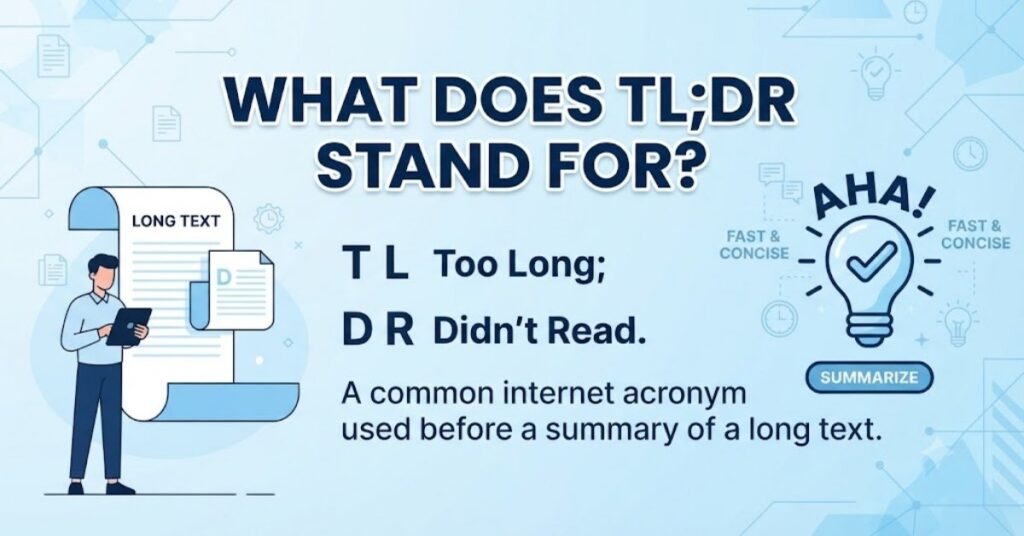
Many people type TL DR with a space, while others write TLDR or TL;DR with a semicolon. They all mean exactly the same thing. The full form is “Too Long; Didn’t Read.” The phrase started as a casual shorthand online, but today it appears across digital communication, business emails, forums, and even workplace chats. No matter how you write it, the meaning doesn’t change.
You can place TLDR before or after a long message. It tells readers they’ll find a short summary instead of reading every detail. That’s why TLDR meaning has become familiar to millions of internet users around the world.
Common places you’ll see TL DR:
- Reddit discussions
- Internet forums
- Slack messages
- WhatsApp chats
- Messenger conversations
- Business communication
- Blog posts
Conversation example:
Chris: Can you explain the report quickly?
Taylor: TLDR: Sales increased this month and profits improved.
⚡ What Does TLDR Mean?
The TLDR meaning is “Too Long; Didn’t Read.” It gives readers a short summary after a long piece of content. Instead of spending several minutes reading every paragraph, people can understand the key point almost instantly. That’s one reason TLDR has become so popular across social media and online communities. It respects your attention span while keeping communication clear and useful.
Although TLDR began as internet slang, many professionals now use it in semi-formal writing. You’ll often see it in reports, workplace emails, newsletters, and project updates. Used correctly, it makes information easier to scan without removing important details.
TLDR helps you:
- Skim content faster.
- Understand the main idea.
- Save valuable time.
- Improve online etiquette.
- Read long posts more efficiently.
Conversation example:
Jordan: What’s the article about?
Morgan: TLDR: It’s a beginner’s guide to digital communication.
TLDR Meaning in Internet Slang
In internet slang, TLDR meaning refers to a short summary added to long content. Online readers move quickly from one post to another, so many people don’t have time to read everything. A TLDR section solves that problem. It delivers the important information in one or two simple sentences. That’s why it remains one of the most recognized forms of casual shorthand.
The phrase became popular on internet forums before spreading to Reddit, Twitter, Discord, TikTok, Instagram, and many other platforms. Today, writers and creators use it because readers appreciate quick, helpful summaries instead of walls of text.
People commonly use TLDR when:
- Reading long Reddit discussions.
- Posting detailed stories.
- Writing blog articles.
- Sharing opinions online.
- Explaining complex topics.
Conversation example:
Emma: That thread has hundreds of comments.
Ryan: Scroll to the TLDR. You’ll get the quick takeaway.
🕰️ TLDR Origin and Popularity of TLDR
The history of TLDR meaning goes back to the early 2000s. Internet users on forums and communities like 4chan started using the phrase as a funny way to summarize long posts. Soon after, Reddit users adopted it, which helped the abbreviation spread across the web. As digital communication evolved, TLDR became part of everyday online language.
Today, respected language references such as Merriam-Webster and Oxford Languages recognize the term because it has become so common. You’ll now find TLDR in blogs, Slack conversations, business communication, and social media. What began as internet slang has become a practical writing tool for millions.
Timeline:
- Early 2000s — Appeared on internet forums.
- Mid-2000s — Spread through 4chan.
- 2010s — Became popular on Reddit and Twitter.
- Today — Used in workplaces, blogs, and social media.
Conversation example:
Noah: Has TLDR been around for years?
Olivia: Yes. It started during the early internet slang era and never disappeared.
💬 TLDR Meaning in Different Contexts
The TLDR meaning stays the same, but people use it differently depending on the situation. In casual chats, it gives friends a quick version of a long story. In business communication, it highlights important decisions at the beginning or end of an email. Writers and bloggers use it to help readers understand lengthy articles. Managers often include TLDR sections in reports so teams can spot key actions without reading every detail.
You should still choose the right setting. TLDR works well in workplace emails and semi-formal writing, but it usually doesn’t belong in academic papers, legal documents, or job applications where a more formal summary fits better.
Where TLDR is commonly used:
- Messenger
- Discord
- Slack
- TikTok
- Workplace emails
- Reports
- Business communication
Conversation example:
Manager: Can everyone read the update before the meeting?
Employee: I read the TLDR first. Now I know the key action points.
TLDR Meaning in Chat
The TLDR meaning in chat is still “Too Long; Didn’t Read.” People use it when messages become too long to read comfortably. Instead of scrolling through several paragraphs, they ask for the main point. A quick TLDR keeps the conversation moving and saves everyone time.
You’ll often see TLDR in WhatsApp, Messenger, Discord, Slack, and group chats. Friends, classmates, and coworkers use it every day. It isn’t usually rude when used politely. Instead, it helps make digital communication faster and easier to follow.
People use TLDR in chat to:
- Summarize long messages.
- Ask for a quick explanation.
- Keep conversations short.
- Improve clarity in communication.
- Save time during busy chats.
Conversation example:
Emma: I sent you five paragraphs.
Jake: TLDR? I’m heading into a meeting.
Emma: Sure. We changed the date to Friday.
What Does TLDR Mean in a Relationship?
The TLDR meaning doesn’t change in a relationship, but the way you use it matters. When emotions are involved, asking for a TLDR can sound caring or dismissive depending on your tone. If your partner shares something important, it’s usually better to read the whole message before replying.
A short summary can still help when you’re discussing plans or explaining a situation. The goal is better communication, not avoiding the conversation. Kind words and clear explanations always work better than rushing through emotional topics.
Good ways to use TLDR:
- Summarize travel plans.
- Explain a misunderstanding.
- Share the key point calmly.
- Avoid confusion.
- Keep conversations clear.
Conversation example:
Chris: That was a long message.
Taylor: TLDR: I felt ignored yesterday and wanted to talk about it.
Is TLDR Professional?
Yes, TLDR meaning fits many professional situations when you use it correctly. Many managers and business professionals include a TLDR at the top of workplace emails or reports. It helps busy readers understand the main message before reading the details.
However, every workplace is different. Some companies welcome casual shorthand, while others prefer more formal language. You should avoid TLDR in academic papers, legal documents, contracts, and job applications because those documents require a formal style.
TLDR works well in:
- Business emails.
- Project updates.
- Team reports.
- Slack messages.
- Internal communication.
Conversation example:
Manager: Did everyone review the report?
Employee: Yes. The TLDR gave me the main action items first.
TLDR Meaning in Business
In business, the TLDR meaning helps teams communicate faster. Long emails often contain deadlines, approvals, and project updates. Adding a short summary makes those details easier to spot. That’s why many companies encourage employees to include a TLDR in business communication.
A good business TLDR should stay short and direct. It highlights the decision, deadline, or next step without repeating the entire email. This simple habit improves clarity in communication and reduces confusion across teams.
Business TLDR examples include:
- Project approved.
- Meeting moved to Tuesday.
- Budget accepted.
- Client signed the agreement.
- Submit reports before Friday.
Conversation example:
Sarah: Did the client reply?
Mark: TLDR: They approved the proposal and want us to begin Monday.
💬 Examples of TLDR in Conversations
Seeing the TLDR meaning in real conversations makes it much easier to understand. People use it across social media, business communication, and casual chats. The wording stays the same, but the situation changes depending on the platform.
Whether you’re texting a friend or replying to a workplace email, TLDR helps people get the quick takeaway without reading every detail. That’s one reason it has become part of modern online etiquette.
Text message
Alex: I spent all weekend fixing my computer.
Jamie: TLDR?
Alex: I finally got everything working.
Post: I tested five laptops this month.
TLDR: The cheapest one gave the best value.
Business email
TLDR: The client approved the budget. Start phase two next week.
Story: I tried every coffee shop downtown.
TLDR: The local café won easily.
🔍 Similar or Related Terms
The TLDR meaning belongs to a larger group of internet abbreviations that make digital communication quicker. While each one has a different purpose, they all help readers save time and understand information faster.
You’ll often see these terms together on Reddit, Twitter, Instagram, Slack, and workplace emails. Learning them makes online conversations much easier to follow.
| Term | Meaning | Example |
| ICYMI | In Case You Missed It | ICYMI, the update is live. |
| FYI | For Your Information | FYI, the meeting starts at 2 PM. |
| BTW | By The Way | BTW, your package arrived. |
| IMO | In My Opinion | IMO, this option works best. |
| IMHO | In My Humble Opinion | IMHO, we should wait another day. |
Conversation example:
Ben: BTW, did you read the update?
Lucy: Yes. The TLDR saved me a lot of time.
🧠 How to Use TLDR Correctly
Using the TLDR meaning correctly is easy once you know the purpose. Always place it before or after a long message. Then write one or two short sentences that explain the main point. Readers should understand the message without reading everything else.
Keep the summary simple and avoid adding new information. A TLDR should make reading easier, not create more questions. Think of it as a shortcut that respects your reader’s time.
Best practices
- Keep it short.
- Mention the main idea.
- Use simple language.
- Place it clearly.
- Match the original message.
Avoid
- Writing a long TLDR.
- Leaving out important details.
- Using it in formal legal documents.
- Adding unrelated information.
Conversation example:
Nina: My email was really long.
Ryan: The TLDR at the top made it much easier to understand.
⚠️ Common Mistakes or Misinterpretations
Many people understand the TLDR meaning, but they still make small mistakes. Some believe TLDR sounds rude every time. That’s not true. In most situations, people use it simply to save time and improve clarity.
Another common mistake is writing “TLDR” without adding a summary. That defeats the entire purpose. Others use it in formal documents where a professional executive summary would work better.
Common mistakes include:
- Forgetting the summary.
- Using it in job applications.
- Adding too much detail.
- Assuming it’s always disrespectful.
- Confusing it with ignoring someone’s message.
Conversation example:
Alex: I only wrote “TLDR.”
Jamie: Add a short summary. Otherwise readers won’t know the main point.
FAQ
What is the TLDR meaning in texting?
The TLDR meaning in texting is “Too Long; Didn’t Read.” It gives someone a quick summary of a long message.
Is TLDR internet slang?
Yes. It started as internet slang before becoming common in business communication and social media.
Is TLDR rude?
Not usually. Tone and context matter more than the abbreviation itself.
Where is TLDR commonly used?
People use it on Reddit, Discord, WhatsApp, Messenger, Slack, Instagram, TikTok, blogs, and workplace emails.
Can I use TLDR in business?
Yes. Many business professionals include it in reports and emails to highlight key information.
Should I use TLDR in academic papers?
No. Academic papers, legal documents, and job applications usually require formal summaries instead.
Conclusion
The TLDR meaning has become an important part of modern digital communication. It helps students, writers, bloggers, managers, and internet users share information quickly without losing the main idea. Whether you’re reading Reddit, replying on Slack, sending workplace emails, or chatting with friends, a clear TLDR saves time and improves clarity.
Use TLDR when you want readers to understand the key takeaway fast. Keep the summary short, accurate, and easy to read. When you use it in the right setting, it becomes a helpful tool instead of just another internet abbreviation. Knowing the TLDR meaning will help you communicate more clearly in today’s fast-moving online world.

Harry Collins is a passionate content writer at OkyTechy who specializes in explaining word meanings, internet slang, abbreviations, and digital terminology. He focuses on creating clear, informative, and reader friendly articles that help audiences better understand modern language and online communication.