
The invictus meaning is simple but powerful. It comes from Latin and means “unconquered” or “undefeated.” The word often describes strength and courage. It can show that someone refuses to give up. The term became famous through William Ernest Henley’s poem Invictus. The poem focuses on courage during hard times. It shows how people can stay strong when life feels difficult. This gives the word a deeper meaning beyond its basic translation.
Today, Invictus appears in many places. People use it in quotes, tattoos, books, sports, and personal mottos. It can represent inner strength, confidence, and resilience. It does not always mean winning every battle. Instead, it suggests staying strong when facing problems. The word can remind you to keep going after setbacks. Its message is clear and timeless. Invictus represents the courage to remain strong, even when circumstances are tough.
✍️ What Does Invictus Mean?
“Invictus” is a Latin word that means “unconquered,” “undefeated,” or “not defeated.” It describes someone or something that cannot easily be overcome.
The word carries a powerful sense of inner strength. It suggests standing firm even when life becomes difficult.
In modern English, people often use Invictus as a motivational word. It can describe courage, confidence, independence, and resilience.
The word can suggest:
- Unconquered
- Undefeated
- Unbeaten
- Strong-willed
- Resistant to defeat
- Mentally resilient
The word also became widely recognised because of William Ernest Henley’s 1875 poem Invictus. The poem presents a speaker who refuses to surrender to suffering or hardship.
Conversation example:
Person A: “What does Invictus mean?”
Person B: “It means unconquered or undefeated.”
Person A: “So it represents strength?”
Person B: “Exactly. It often represents resilience and courage.”
How to Pronounce Invictus
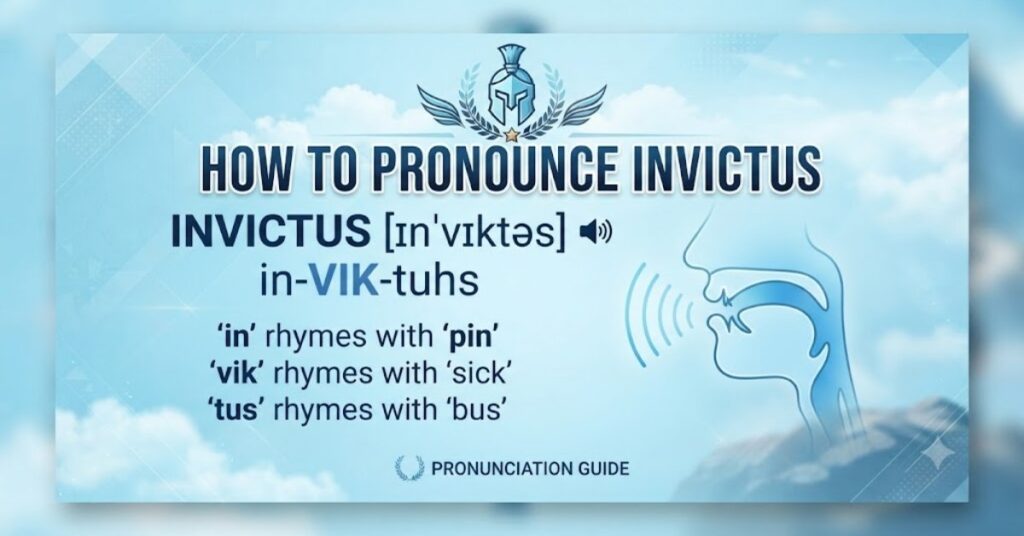
The English pronunciation of Invictus is commonly given as in-VIK-tus.
The stress usually falls on the middle syllable. The word has three simple parts: “in,” “vik,” and “tus.”
The Latin pronunciation can differ from the modern English pronunciation. Classical Latin pronunciation is closer to in-WIK-toos, depending on the reconstruction and pronunciation system being used.
For everyday English conversations, in-VIK-tus is the easiest pronunciation to use.
Simple pronunciation guide:
- In → like “in”
- vik → rhymes roughly with “pick”
- tus → sounds like “tus”
Conversation example:
Person A: “How do you say Invictus?”
Person B: “In-VIK-tus.”
Person A: “What does it mean?”
Person B: “Unconquered or undefeated.”
📜 Origin and Popularity
The word Invictus comes from Latin. It is the masculine singular form of the Latin adjective invictus, meaning unconquered or undefeated.
The term has remained popular because it expresses a universal human idea: refusing to be defeated by difficult circumstances.
Its popularity grew significantly through William Ernest Henley’s poem Invictus. Written in the 19th century, the poem became strongly associated with courage, personal control, and endurance.
Today, Invictus appears in many modern contexts.
Common uses include:
- Motivational quotes
- Poetry
- Tattoos
- Personal mottos
- Sports branding
- Books and films
- Military and leadership themes
The word also appears in historical and religious contexts, especially in the phrase Sol Invictus, meaning “Unconquered Sun.”
Conversation example:
Person A: “Why is Invictus still popular?”
Person B: “Because its message of resilience still feels relevant today.”
🕰️ Historical Background
The history of Invictus reaches back to the Latin language and the Roman world. Latin writers used invictus to describe people, forces, or qualities that had not been conquered.
The word could describe military strength or personal courage. It could also carry religious meaning when connected with Roman deities.
One famous historical expression is Sol Invictus, the “Unconquered Sun.” The phrase became associated with Roman religious traditions and the emperor Aurelian in the third century CE.
Centuries later, William Ernest Henley gave the word a new literary identity through his poem Invictus. His poem became famous for its strong message of endurance.
Historical connections include:
- Ancient Latin vocabulary
- Roman culture
- Imperial symbolism
- Sol Invictus
- William Ernest Henley
- Modern motivational language
Conversation example:
Person A: “Is Invictus a modern word?”
Person B: “No. It comes from ancient Latin and has a long history.”
Invictus Meaning in Latin
In Latin, invictus means “unconquered,” “undefeated,” or “unvanquished.” It comes from the Latin verb vinco, meaning “to conquer,” “to overcome,” or “to defeat.”
The prefix in- creates a negative sense in this word. Therefore, invictus expresses the idea of something that has not been conquered.
The exact form can change depending on Latin grammar. Invictus is the masculine singular form. Other forms appear when Latin grammar requires a different gender, number, or case.
Basic Latin idea:
- vinco = I conquer
- victus = conquered
- invictus = unconquered
This makes the word especially powerful as a symbol. It does not simply mean “strong.” It suggests surviving opposition without being defeated.
Conversation example:
Person A: “What is the literal Latin meaning of Invictus?”
Person B: “Unconquered or undefeated.”
Person A: “Does it imply resilience?”
Person B: “Yes, especially in modern usage.”
Popular Latin Phrases Using Invictus
The word invictus appears in several Latin expressions and historical references. These phrases often connect the idea of being unconquered with strength, victory, or divine power.
The best-known expression is Sol Invictus, meaning “Unconquered Sun.” It became an important phrase in Roman religious history.
Another related expression is Deus Invictus, which can be translated as “Unconquered God.” It reflects the use of invictus as an honorific connected with divine power.
Popular examples include:
- Sol Invictus — Unconquered Sun
- Deus Invictus — Unconquered God
- Invictus — Unconquered or undefeated
- Invicta — Unconquered, feminine form
- Invictum — Unconquered, neuter form
These expressions show how the Latin word could carry different meanings depending on context.
Conversation example:
Person A: “What does Sol Invictus mean?”
Person B: “It means ‘Unconquered Sun.’”
Person A: “Is Invictus itself Latin?”
Person B: “Yes. It means unconquered or undefeated.”
Sol Invictus Meaning
Sol Invictus is a Latin phrase meaning “Unconquered Sun.” Sol means “sun,” while invictus means “unconquered” or “undefeated.”
The phrase has an important place in Roman religious history. It became especially associated with the Roman emperor Aurelian, who established an official cult of Sol Invictus in the late third century CE.
The expression presents the sun as powerful, enduring, and victorious. The idea of an unconquered sun naturally connects with themes of light overcoming darkness and strength overcoming adversity.
However, Sol Invictus should not simply be treated as another word for “Invictus.” Invictus is a general Latin adjective, while Sol Invictus is a specific historical and religious expression.
Simple breakdown:
- Sol = Sun
- Invictus = Unconquered
- Sol Invictus = Unconquered Sun
- Historical setting = Roman Empire
- Symbolic idea = Endurance and victory
Conversation example:
Person A: “What is the Sol Invictus meaning?”
Person B: “It means ‘Unconquered Sun’ in Latin.”
Person A: “Why is it important?”
Person B: “It has strong historical and religious connections to ancient Rome.”
Semper Invictus Meaning
Semper Invictus is a Latin phrase that can be understood as “always unconquered” or “always undefeated.” The word semper means “always,” while invictus means “unconquered.”
The phrase suggests lasting strength. It describes someone who continues to stand firm despite pressure, failure, or hardship.
It can work as a personal motto or motivational phrase.
Key ideas:
- Always undefeated
- Never conquered
- Constant strength
- Resilience
- Determination
Conversation example:
Person A: “What does Semper Invictus mean?”
Person B: “It means always unconquered or always undefeated.”
Person A: “So it represents determination?”
Person B: “Yes. It suggests never giving up.”
Morior Invictus Meaning
Morior Invictus is commonly interpreted as “I die unconquered” or “I shall die unconquered.” The phrase combines morior, meaning “I die,” with invictus, meaning “unconquered.”
It expresses an extreme form of determination. The speaker accepts death rather than accepting defeat or surrender.
The phrase has a dramatic and heroic tone. It often appears in fictional, military, historical, or motivational settings.
The phrase can represent:
- Refusal to surrender
- Courage
- Defiance
- Honor
- Endurance
- Personal strength
Conversation example:
Person A: “Why would someone use Morior Invictus?”
Person B: “It can express the idea of facing the end without being defeated.”
Person A: “Is it stronger than simply saying Invictus?”
Person B: “Yes. It carries a much more dramatic meaning.”
Spiritus Invictus Meaning
Spiritus Invictus can be translated as “unconquered spirit” or “undefeated spirit.” Spiritus can mean “spirit,” “breath,” or “soul,” depending on context.
The phrase is often understood symbolically. It suggests a person whose inner strength remains alive despite difficult circumstances.
Unlike some expressions involving invictus, this phrase is especially easy to understand as a modern motivational concept.
It can represent:
- Inner strength
- Courage
- Hope
- Resilience
- Mental toughness
- Refusing to give up
Conversation example:
Person A: “What does Spiritus Invictus suggest?”
Person B: “It suggests an unconquered or undefeated spirit.”
Person A: “Could it work as a personal motto?”
Person B: “Yes, especially for someone focused on resilience.”
🌍 Invictus Meaning in Different Contexts
The Invictus meaning can change slightly depending on where you see the word. Its basic Latin sense remains “unconquered” or “undefeated.”
However, literature may connect it with courage. History may connect it with Roman religion. Sports may use it to express competitive strength.
This flexibility explains why the word remains popular today.
Common contexts include:
- Literature and poetry
- History
- Religion
- Philosophy
- Sports
- Motivation
- Pop culture
- Personal mottos
The central message usually stays similar: something has resisted defeat.
Conversation example:
Person A: “Does Invictus always mean exactly the same thing?”
Person B: “The core meaning stays the same, but its symbolism can change with context.”
📚 In Literature
Literature often uses Invictus as a symbol of courage and resistance. The word became particularly famous through William Ernest Henley’s poem Invictus.
In literary writing, the term can represent a person who refuses to surrender to suffering. It can also symbolize independence and control over one’s response to hardship.
The word feels powerful because it says more than simply “strong.” It suggests that challenges have failed to defeat the person.
Literary themes often include:
- Courage
- Resilience
- Freedom
- Defiance
- Self-control
- Endurance
Conversation example:
Person A: “Why does Invictus sound so powerful in literature?”
Person B: “Because it can symbolize someone who remains unconquered through hardship.”
Invictus Meaning in the Poem
In Henley’s poem Invictus, the word represents an unconquered inner spirit. The poem focuses on suffering, courage, responsibility, and the determination to remain mentally strong.
The speaker faces hardship but refuses to let circumstances completely control his spirit. This gives Invictus a deeper meaning than simply “undefeated.”
The poem is often remembered as a statement of personal resilience.
Its major themes include:
- Courage during suffering
- Inner strength
- Personal responsibility
- Defiance
- Perseverance
- Mental freedom
Conversation example:
Person A: “What does Invictus symbolize in Henley’s poem?”
Person B: “It symbolizes an inner spirit that refuses to be conquered.”
Person A: “Is it about physical victory?”
Person B: “Mostly, it focuses on mental and emotional strength.”
🎬 In Pop Culture
In pop culture, Invictus often works as a symbol of strength. It can appear in movie titles, character names, music, tattoos, brands, and motivational messages.
Creators like the word because it sounds memorable and carries a powerful meaning. It can quickly suggest victory, resistance, or determination.
Modern usage does not always follow the exact historical meaning. Sometimes Invictus simply creates a bold, inspirational feeling.
You may see it used for:
- Movie titles
- Music
- Character names
- Clothing
- Tattoos
- Brands
- Social media captions
Conversation example:
Person A: “Why do people use Invictus in modern media?”
Person B: “Because it sounds powerful and suggests strength that cannot be defeated.”
🏋️ In Sports and Motivation
In sports, Invictus can represent an athlete’s determination to keep competing. It does not necessarily mean winning every match.
Instead, it can describe the mindset of continuing after failure. An athlete may lose a competition but still maintain an “unconquered” attitude.
That makes the word useful for motivational slogans and team identities.
It can represent:
- Mental toughness
- Discipline
- Persistence
- Competitive spirit
- Recovery after failure
- Confidence
Conversation example:
Coach: “Why did you choose Invictus for the team motto?”
Player: “Because we want to keep fighting even after setbacks.”
Coach: “Exactly. It’s about resilience, not just winning.”
⛪ In Religion and Philosophy
The Invictus meaning can also connect with religious and philosophical ideas about strength, endurance, and something that cannot be overcome.
Historically, invictus appeared in Roman religious language. Sol Invictus, or “Unconquered Sun,” is one well-known example.
Philosophically, the word can represent inner freedom. A person may not control everything that happens, but they can try to control their response.
Related ideas include:
- Inner freedom
- Courage
- Endurance
- Faith
- Self-control
- Resilience
Conversation example:
Person A: “Can Invictus have a philosophical meaning?”
Person B: “Yes. It can represent remaining mentally strong when circumstances are difficult.”
💬 Examples of Invictus in Use
“Invictus” works best when you want to express the idea of being unconquered, undefeated, or impossible to overcome.
It can describe a person, spirit, attitude, or symbolic idea.
Examples:
- “She carries an Invictus spirit.”
- “His Invictus mindset helped him continue.”
- “The team chose Invictus as its motto.”
- “That tattoo represents an Invictus attitude.”
- “He remained Invictus after years of hardship.”
Conversation example:
Person A: “What does this tattoo mean?”
Person B: “It says Invictus.”
Person A: “Why did you choose it?”
Person B: “It reminds me to remain strong when life gets difficult.”
🔗 Similar or Related Terms
Several English and Latin words have meanings connected to Invictus. Some focus on victory, while others emphasize strength or resistance.
Knowing these related terms can make the word easier to understand.
Related words include:
- Unconquered — not defeated
- Undefeated — never beaten
- Unvanquished — not overcome
- Resilient — able to recover
- Tenacious — persistent and determined
- Victorious — having achieved victory
- Fortis — Latin for brave or strong
- Perseverance — continued effort despite difficulty
Invictus does not mean exactly the same thing as “victorious.” A person can remain unconquered without winning every battle.
Conversation example:
Person A: “Is Invictus the same as victorious?”
Person B: “Not exactly. Invictus focuses more on not being conquered.”
✅ How to Use “Invictus” Correctly
Use Invictus when you want to describe something as unconquered or undefeated. It works especially well in symbolic or motivational contexts.
Because it is a Latin word, it can sound formal or dramatic in ordinary English conversation.
For simple everyday writing, “undefeated” or “unconquered” may sound more natural.
Good uses include:
- “Invictus is my personal motto.”
- “The team adopted Invictus as its slogan.”
- “Her Invictus spirit inspired everyone.”
- “The poem presents an Invictus mindset.”
Avoid using it when you simply mean “successful.” The word specifically carries the idea of resisting defeat.
Conversation example:
Person A: “Can I call someone Invictus?”
Person B: “Yes, especially in a symbolic or poetic context.”
⚠️ Common Mistakes or Misinterpretations
One common mistake is assuming Invictus simply means “winner.” Its closer meaning is “unconquered” or “undefeated.”
Another mistake involves treating every phrase containing invictus as a fixed ancient Latin expression. Some modern phrases may be newly created or used creatively.
People also sometimes confuse Invictus with victorious. They are related ideas, but they are not identical.
Remember these points:
- Invictus = unconquered
- It does not automatically mean “winner”
- Context affects the symbolism
- Latin grammar can change the word’s form
- Modern phrases may be creative adaptations
Conversation example:
Person A: “Does Invictus mean someone always wins?”
Person B: “Not necessarily. It focuses on remaining unconquered.”
Invictus Meaning in Other Languages
The basic Invictus meaning can be translated into many languages, although exact wording depends on context.
In English, the closest translations are “unconquered” and “undefeated.” Other languages use their own words to express the same idea.
Examples include:
- English: Unconquered / Undefeated
- Spanish: Invicto
- French: Invaincu
- Italian: Invitto
- Portuguese: Invicto
- German: Unbesiegt
- Dutch: Onverslagen
- Romanian: Neînvins
The Latin word itself remains popular because it feels concise and timeless. It is also easy to recognize in mottos, tattoos, literature, and branding.
Conversation example:
Person A: “Is Invictus only understood in English?”
Person B: “No. Its Latin meaning can be translated into many languages.”
❓ FAQ Section
What does Invictus mean?
Invictus is a Latin word meaning “unconquered,” “undefeated,” or “unvanquished.” It often symbolizes strength and resilience.
What does Invictus mean in Latin?
In Latin, invictus means unconquered or undefeated. It comes from the Latin verb vinco, meaning to conquer or overcome.
What does Invictus mean in the poem?
In Henley’s Invictus, the word represents an unconquered inner spirit that refuses to surrender despite suffering and hardship.
Is Invictus a positive word?
Yes. Modern usage usually gives Invictus a positive meaning connected with courage, resilience, determination, and strength.
What does Sol Invictus mean?
Sol Invictus means “Unconquered Sun.” It is a historical Latin expression connected with Roman religious traditions.
Is Invictus the same as victorious?
No. Invictus means unconquered or undefeated, while “victorious” means having won or achieved victory.
Conclusion
The invictus meaning is simple yet powerful. It means “unconquered,” “undefeated,” or “unbeaten” in Latin. The invictus meaning often connects with strength, courage, and resilience. It became widely known through William Ernest Henley’s famous poem Invictus. The poem presents a strong message about facing pain without giving up. This gives the invictus meaning a deeper emotional value. It can describe someone who stays strong during hard times. It can also represent inner courage and determination.
Today, the invictus meaning appears in literature, sports, tattoos, mottos, and motivational messages. The phrase invictus meaning can suggest confidence and mental strength. It reminds people to keep moving forward after setbacks. The invictus meaning is not simply about winning. It is about refusing to be defeated in spirit. That is why Invictus remains a powerful word with lasting meaning in 2026.

Harry Collins is a passionate content writer at OkyTechy who specializes in explaining word meanings, internet slang, abbreviations, and digital terminology. He focuses on creating clear, informative, and reader friendly articles that help audiences better understand modern language and online communication.