
If you’ve watched anime or spent time online, you’ve probably heard the phrase onii chan meaning and wondered what it really means. At first, it may sound confusing. Some people think it has a romantic meaning, while others only know it from memes. The truth is much simpler. In Japanese, it is a warm and friendly way for a younger sibling to call an older brother. Still, anime and internet culture have given the word extra meanings that often confuse new fans.
This guide explains everything in simple English. You’ll learn its real meaning, correct pronunciation, and how Japanese families use it every day. You’ll also see how anime, manga, and online communities changed the way people understand the word. By the end, you’ll know the difference between real-life usage and popular internet myths, so you can use the term with confidence.
What Does Onii Chan Mean?
Onii Chan meaning is simple at its core. Onii-chan (お兄ちゃん) is a Japanese word that means older brother. A younger sibling, especially a younger sister, uses it as an affectionate term to address her big brother. The word combines onii with the honorific suffix -chan, which adds warmth and closeness.
Unlike the spelling Oni (demon), Onii-chan, Oniichan, Onii chan, Oni-chan, and Onichan all refer to the same family word, although Onii-chan is the most accurate Romanization.
For example:
- Sister: “Onii-chan, can you help me?”
- Brother: “Sure. What do you need?”
- Sister: “Arigato!”
In Japanese culture, this word reflects a close sibling relationship. Today, thanks to anime, manga, internet culture, and fandom, many people around the world recognize the phrase even if they don’t speak Japanese.
What Does Onii Chan Mean in English?
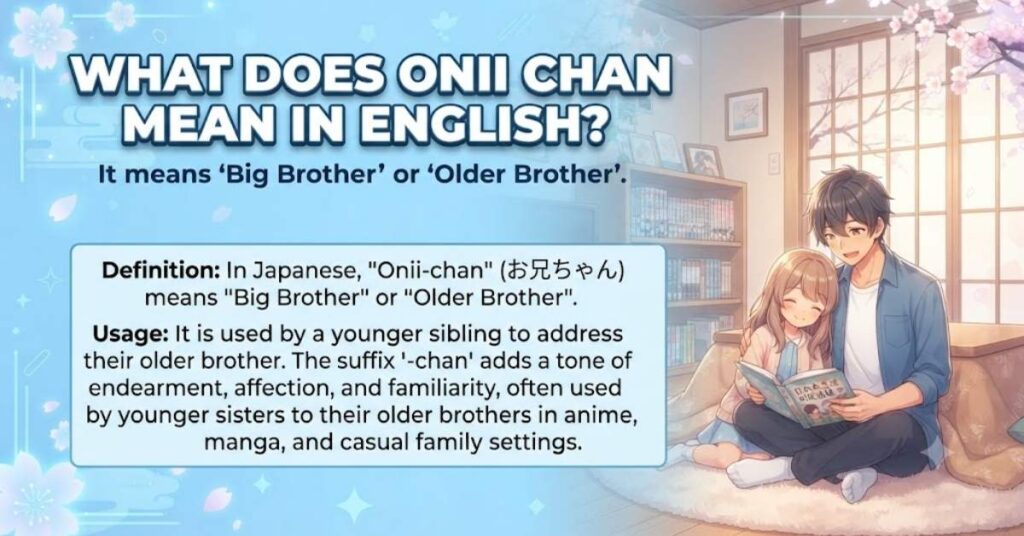
The closest English translation of the Onii Chan meaning is “big brother” or “big bro.” However, those translations don’t fully capture the warmth carried by Japanese honorifics. The honorific suffix -chan makes the word sound loving, playful, and familiar.
English doesn’t have an exact equivalent. Instead, it relies on tone of voice. That’s why many anime fans continue using Onii-chan instead of translating it.
Examples include:
- Onii-chan → Big brother
- Onii chan → Big bro
- Oniichan → Dear big brother
Conversation example:
- “Good morning, Onii-chan!”
- “Morning! Ready for breakfast?”
Although English speakers often use the word in meme culture or fan fiction, its original meaning remains a warm family expression between siblings.
What Does Onii Chan Mean in Japanese?
In Japan, the Onii Chan meaning is completely normal and family-friendly. Millions of children say Onii-chan every day when speaking to their older brother. The word carries affection rather than formality.
It is written as:
- お = respectful prefix
- 兄 = Kanji for older brother
- ちゃん = Hiragana honorific suffix
Together they form お兄ちゃん.
The pronunciation is Oh-nee-chan, with a long “ee” sound. This follows standard Japanese Romanization rules.
Conversation example:
- “Ohayo, Onii-chan!”
- “Good morning.”
- “Let’s eat breakfast.”
In real life, Japanese families use this naturally. Unlike many online jokes, the word has nothing unusual about it. It is simply one of many everyday family words used in Japanese homes.
What Does Onii Mean in Japanese?
To understand the full Onii Chan meaning, it helps to look at the base word. Onii comes from Ani (兄), which means older brother. Adding the respectful prefix “o” makes it softer and more polite.
Usually, onii appears with an honorific such as:
- Onii-chan – affectionate
- Onii-san – polite
- Onii-sama – very respectful
One common mistake is confusing Onii with Oni (demon). They look similar in English spelling, but they have completely different meanings. The extra “i” changes everything.
Quick example:
- Onii = Older brother ✅
- Oni = Demon or ogre ❌
This small spelling difference is one reason why learning correct Romanization is important when studying Japanese.
Onii-San Meaning — What’s the Difference?
Many people wonder about the difference between Onii-chan and Onii-san. Both mean older brother, but they express different levels of closeness.
| Term | Meaning | Common Use |
| Onii-chan | Cute and affectionate | Family and young children |
| Onii-san | Polite and respectful | Family or strangers |
| Onii-sama | Very formal | Anime and noble characters |
The Onii Chan meaning feels warmer because -chan shows affection. By comparison, Onii-san sounds more respectful. Onii-sama is much more formal and often appears in historical stories or anime.
Conversation example:
- Child: “Onii-chan, let’s play!”
- Teenager: “Onii-san, could you help me?”
The right choice depends on age, personality, and the relationship between the speakers.
What Does Onii Chan Mean for a Girl / From a Girl?
The Onii Chan meaning doesn’t change based on gender. Instead, it depends on who is speaking. Most often, a younger sister says Onii-chan to her older brother.
This is one of the most common family expressions in Japan.
If someone calls a girl Onii-chan, that would usually sound incorrect because the female version is Onee-chan, while Onee-san and Onee-sama are more polite forms.
Example conversation:
- Sister: “Onii-chan, wait for me!”
- Brother: “Come on. We’re going.”
Related family terms include:
- Imouto = younger sister
- Otouto = younger brother
- Nee-chan = casual older sister
- Nii-chan = casual older brother
These words help show family roles while keeping conversations warm and natural.
What Does Onii Chan Mean Sexually?
The original Onii Chan meaning is not sexual. It simply means older brother and serves as a loving family expression in everyday Japanese life.
However, many people ask this question because of anime, hentai, ecchi anime, and online discussions. Certain fictional stories use Onii-chan in romantic situations between characters, creating confusion outside Japan.
It’s important to separate fiction from reality.
In real life:
- Onii-chan = family word
- Normal household expression
- Used by children every day
Online:
- Sometimes linked to adult anime
- Appears in memes
- Often misunderstood by new anime fans
Understanding this difference helps explain why the word has two very different reputations depending on where people first encounter it.
Why Is Onii-Chan Sexualized?
The Onii Chan meaning became sexualized because of specific parts of anime, manga, and the imouto genre. These fictional stories introduced the word into situations involving the taboo relationship trope, even though that isn’t how real Japanese families use it.
Several factors helped spread this image:
- Adult hentai content
- Ecchi anime
- Viral internet clips
- Meme culture
- Global fandom
As these scenes spread online, many viewers assumed the word always carried that meaning.
In reality, that isn’t true. The sexualization belongs to certain fictional genres, not to Japanese culture itself. Most Japanese people still use Onii-chan exactly as they always have—as an affectionate way to address an older brother within a normal sibling relationship.
What Does Onii Chan Mean in Anime?
In anime, the Onii Chan meaning usually stays true to its original purpose. Younger siblings use it when speaking to an older brother, helping viewers immediately understand the family relationship and the characters’ personalities.
You’ll hear the word in many situations:
- Happy family scenes
- Funny sibling arguments
- Emotional reunions
- School stories
- Fantasy adventures
Conversation example:
- “Ohayo, Onii-chan!”
- “Morning.”
- “Let’s go to school.”
You’ll also hear famous expressions such as Onii-chan no baka, Onii-chan daisuki, Onii-chan yamete kudasai, Ara ara, Daisuki, Sayonara, and Arigato. Some internet jokes even include Ohio onii-chan or UWU onii-chan. These phrases became popular through anime tropes, online communities, and internet culture, although their meanings depend heavily on context.
Onii-Chan Anime Girl — Common Tropes Explained
The Onii Chan meaning becomes even more recognizable in anime because of the famous “little sister” character. This character is often an Imouto who lovingly calls her older brother Onii-chan. The phrase quickly tells viewers that the characters share a close sibling relationship.
You’ll often notice these common anime tropes:
- Cheerful and energetic personality
- Protective of her brother
- Easily embarrassed or emotional
- Calls him Onii-chan throughout the story
- Creates funny family moments
Conversation example:
- Sister: “Ohayo, Onii-chan!”
- Brother: “Morning. Ready for school?”
- Sister: “Let’s go!”
Some series use this character archetype in wholesome ways, while others exaggerate it for comedy or drama. Anime, manga, fan fiction, and fandom have helped make this one of the best-known family dynamics in Japanese storytelling.
What Does Onii Chan Mean in Hentai?
The original Onii Chan meaning never changes. It still means older brother. However, in hentai, the word appears in fictional adult stories, which gives it a different context than everyday Japanese life.
Many people first hear Onii-chan, Oniichan, or Onii chan through adult clips online. That often creates confusion about its true meaning.
Here’s the difference:
- Real life: affectionate family word
- Hentai: fictional adult setting
- Ecchi anime: may include suggestive humor
- Everyday Japanese: completely normal expression
Conversation example (family use):
- Sister: “Onii-chan, can you help me?”
- Brother: “Of course.”
The adult association comes from fiction rather than Japanese culture itself. Understanding real-life usage vs. anime usage helps separate the original meaning from entertainment created for a specific audience.
What Does Onii Chan Mean in Korean?
The Onii Chan meaning belongs to Japanese, not Korean. Although many K-drama and K-pop culture fans compare the words, they come from different languages and traditions.
In Korean, the closest family terms are:
- Oppa – used by a girl for her older brother or an older male she feels close to
- Hyeong – used by a boy for his older brother
These words aren’t direct translations of Japanese honorifics, but they share a similar role inside families.
Conversation example:
- Korean: “Oppa, let’s eat.”
- Japanese: “Onii-chan, let’s eat.”
Because anime is popular in South Korea, many fans also recognize Onii-chan. Still, they understand it as a Japanese word rather than a native Korean expression.
What Does Onii Chan Mean in Chinese?
The Onii Chan meaning is Japanese, not Chinese. Mandarin Chinese has its own affectionate family words for an older brother.
The most common terms include:
- Gēgē (哥哥) – older brother
- Gē (哥) – casual short form
Although Japanese Kanji and Chinese characters share historical roots, the pronunciation and grammar are different.
Conversation example:
- Chinese: “Gēgē, can you help me?”
- Japanese: “Onii-chan, can you help me?”
Many Chinese anime fans know the word Onii-chan because of anime, manga, and internet culture. However, they still recognize it as Japanese rather than Chinese. The languages may look similar in writing, but they belong to separate linguistic systems.
What Does Onii Chan Mean in Spanish?
The Onii Chan meaning doesn’t change in Spanish because it remains a Japanese word. Spanish speakers usually translate it as hermano mayor, which simply means older brother.
Common Spanish equivalents include:
- Hermano mayor – older brother
- Hermano – brother
- Bro – informal slang
Unlike Japanese honorifics, Spanish doesn’t use a suffix like -chan to show affection. Instead, speakers rely on tone and context.
Conversation example:
- Spanish: “Hola, hermano mayor.”
- Japanese: “Hola, Onii-chan.”
Across Spain and Latin America, anime, manga, and fandom have made Onii-chan a familiar word. Many fans leave it untranslated because it preserves the original feeling from Japanese dialogue.
What Does Onii Chan Mean in Japan (Real Life)?
In real Japanese homes, the Onii Chan meaning is simple and ordinary. Children naturally call their older brother Onii-chan every day. There is no hidden meaning or unusual implication.
You’ll hear it in many places:
- At home
- Family gatherings
- Children’s TV shows
- Schools
- Daily conversations
Conversation example:
- “Onii-chan, where are you?”
- “I’m in the kitchen.”
- “Arigato!”
Outside Japan, internet culture, meme culture, and certain anime genres changed how some people view the word. Inside Japan, though, it remains one of many normal Japanese honorifics used to show warmth, respect, and family closeness.
Onii Chan Yamete Kudasai Meaning
The Onii Chan meaning stays the same in this phrase. Yamete kudasai simply means “please stop.” Together, Onii-chan yamete kudasai translates to “Please stop, big brother.”
You’ll hear this phrase in:
- Anime
- Comedy scenes
- Emotional moments
- Internet memes
Conversation example:
- Brother: “I’m teasing you.”
- Sister: “Onii-chan, yamete kudasai!”
- Brother: “Okay, I stopped.”
The phrase later became popular through meme culture, where people often quoted it without understanding the original context. In everyday Japanese, Yamete kudasai is simply a polite request asking someone to stop doing something.
Onii Chan Daisuki Meaning
The Onii Chan meaning becomes more affectionate when combined with Daisuki, which means “I love you very much” or “I really like you.” The complete phrase Onii-chan daisuki means “I love you, big brother.”
This expression commonly appears in:
- Family stories
- Emotional anime scenes
- Childhood memories
- Slice-of-life manga
Conversation example:
- Sister: “Onii-chan daisuki.”
- Brother: “Thank you.”
- Sister: “You’re the best.”
In real Japanese families, this phrase expresses love between siblings. While some online discussions connect it to adult fiction, its original meaning is simply a warm family expression built around affection and gratitude.
Other Onii Chan Phrases Explained
The Onii Chan meaning appears in many popular Japanese phrases. Most of them are simple greetings or everyday expressions, while others became famous because of anime and internet culture.
Here are some common examples:
- Ohayo Onii-chan – Good morning, big brother
- Arigato Onii-chan – Thank you, big brother
- Sayonara Onii-chan – Goodbye, big brother
- Onii-chan no baka – You’re such a dummy, big brother
- Ara ara Onii-chan – A playful “Oh my”
- Ohio Onii-chan – Internet joke based on “Ohayo”
- UWU Onii-chan – Cute online meme expression
Conversation example:
- “Ohayo, Onii-chan!”
- “Morning!”
- “Arigato for helping me yesterday.”
These phrases appear across anime, manga, fan fiction, and online communities. Understanding the context makes them much easier to recognize and use correctly.
Ohayo Onii-Chan
The Onii Chan meaning stays the same in this phrase. Ohayo Onii-Chan simply means “Good morning, big brother.” In Japanese, Ohayo (おはよう) is a friendly morning greeting that people use with family and close friends. When you add Onii-chan, it becomes a warm way for a younger sibling to greet an older brother.
This phrase appears often in anime, manga, and slice-of-life stories because it sounds natural and affectionate.
Common uses:
- Morning greetings at home
- Family conversations
- School-day scenes
- Wholesome anime moments
Conversation example:
- Sister: “Ohayo, Onii-chan!”
- Brother: “Good morning!”
- Sister: “Breakfast is ready.”
Although fans often repeat it online, the phrase is also common in everyday Japanese culture and reflects a close sibling relationship.
Ohio Onii-Chan
Many people confuse Ohio Onii-Chan with Ohayo Onii-Chan, but they are not the same. The Onii Chan meaning doesn’t change. Instead, Ohio is simply the name of the U.S. state, while Ohayo means “good morning” in Japanese.
Because the words sound similar, internet culture and meme culture turned Ohio Onii-Chan into a funny joke. It isn’t a real Japanese phrase.
What it usually means online:
- A playful anime meme
- A spelling joke
- Social media humor
- Fan-created content
Conversation example:
- Friend: “Ohio, Onii-chan!”
- Anime fan: “You mean Ohayo!”
- Friend: “Exactly. It’s just a joke.”
You’ll mostly see this phrase in memes, videos, and fandom, not in everyday Japanese conversations.
Arigato Onii-Chan
The Onii Chan meaning becomes a thankful expression when paired with Arigato (ありがとう). Together, Arigato Onii-Chan means “Thank you, big brother.” It is a sweet and respectful phrase often heard in family conversations.
Children commonly use it after receiving help or kindness from an older brother.
You’ll hear it in:
- Family life
- Anime
- Manga
- Heartwarming scenes
Conversation example:
- Brother: “I finished your homework project.”
- Sister: “Arigato, Onii-chan!”
- Brother: “You’re welcome.”
The phrase shows appreciation while keeping the warm tone created by the honorific suffix -chan. It remains one of the most common and natural expressions found in Japanese culture.
Sayonara Onii-Chan
The Onii Chan meaning doesn’t change in this expression. Sayonara Onii-Chan translates to “Goodbye, big brother.” The word Sayonara (さようなら) usually carries a more emotional or long-term goodbye than a casual farewell.
That’s why many anime scenes use it during heartfelt endings.
Common situations include:
- Leaving home
- Emotional reunions
- Graduation scenes
- Dramatic story endings
Conversation example:
- Sister: “Sayonara, Onii-chan.”
- Brother: “Take care.”
- Sister: “See you soon.”
Although anime often makes the phrase dramatic, Japanese people usually reserve Sayonara for meaningful farewells rather than everyday goodbyes.
Onii-Chan No Baka / Onii-Chan Baka
The Onii Chan meaning remains affectionate even when combined with Baka (バカ). The phrase Onii-Chan no baka or Onii-Chan baka usually means “You’re such a dummy, big brother!” It sounds playful rather than truly insulting.
In anime, siblings often say it after harmless teasing.
You’ll commonly hear it when:
- Someone steals food
- A joke goes too far
- Siblings argue
- Funny misunderstandings happen
Conversation example:
- Brother: “I ate your dessert.”
- Sister: “Onii-Chan no baka!”
- Brother: “I’ll buy another one.”
This expression has become one of the best-known anime tropes because it perfectly captures playful sibling teasing.
Onii-Chan Daisuki
The Onii Chan meaning becomes even warmer when paired with Daisuki (大好き). Onii-Chan Daisuki means “I love you very much, big brother.” It expresses deep affection between family members.
This phrase appears frequently in emotional anime, family dramas, and wholesome manga.
It often expresses:
- Gratitude
- Family love
- Appreciation
- Emotional support
Conversation example:
- Sister: “Onii-Chan daisuki.”
- Brother: “Thank you.”
- Sister: “You’re always there for me.”
Although some online discussions misunderstand the phrase, its original purpose is simply to show genuine love between siblings in everyday Japanese culture.
Ara Ara Onii-Chan
The Onii Chan meaning stays the same here, while Ara ara (あらあら) adds a playful or teasing tone. The phrase loosely means “Oh my, big brother,” or “Well, well, big brother.”
In anime, older female characters often say Ara ara with a calm smile. Fans later mixed it with Onii-Chan for humorous and dramatic effect.
Common uses include:
- Gentle teasing
- Funny dialogue
- Internet memes
- Fan-created jokes
Conversation example:
- Brother: “I forgot again.”
- Sister: “Ara ara, Onii-Chan.”
- Brother: “I knew you’d say that.”
Today, you’ll mostly find this phrase in fandom, fan fiction, and online anime communities.
UWU Onii-Chan
The Onii Chan meaning doesn’t change, but UWU comes from internet slang rather than Japanese. UWU is a text emoticon that shows happiness, cuteness, or excitement.
When people write UWU Onii-Chan, they’re mixing anime culture with online humor.
You’ll usually see it in:
- Social media
- Memes
- Gaming communities
- Anime fandom
Conversation example:
- Friend: “UWU Onii-Chan!”
- Friend 2: “That’s adorable.”
- Friend: “Exactly!”
This phrase isn’t part of everyday Japanese language. Instead, it became popular through internet culture, where anime fans enjoy playful expressions and exaggerated cuteness.
Onii-Chan Chan
The Onii Chan meaning doesn’t change in this unusual phrase. Onii-Chan Chan is not a standard Japanese expression. Most people use it as a joke, nickname, or playful repetition in online conversations.
Repeating -chan isn’t grammatically correct in Japanese, but fans sometimes do it for humor or extra cuteness.
Where you might see it:
- Anime memes
- Fan fiction
- Social media posts
- Online fandom
Conversation example:
- Friend: “Onii-Chan Chan!”
- Anime fan: “That’s not proper Japanese.”
- Friend: “I know. It’s just for fun.”
This phrase highlights how internet culture often changes language for entertainment. While it isn’t correct Japanese, anime fans instantly recognize it as playful and lighthearted.
Full Japanese Honorifics & Family Words Table
Understanding the Onii Chan meaning becomes much easier when you learn the most common Japanese honorifics and family words. These words help show respect, affection, and family relationships. Instead of using first names all the time, Japanese speakers often choose an honorific that matches the relationship.
The table below explains the most common terms you’ll hear in anime, manga, and everyday Japanese culture.
| Japanese Word | Meaning | Common Usage |
| Onii-chan | Older brother (affectionate) | Close family |
| Onii-san | Older brother (polite) | Respectful family use |
| Onii-sama | Older brother (formal) | Noble or dramatic speech |
| Onee-chan | Older sister (affectionate) | Family |
| Onee-san | Older sister (polite) | Respectful |
| Onee-sama | Older sister (formal) | Elegant speech |
| Nii-chan | Casual big brother | Informal |
| Nee-chan | Casual big sister | Informal |
| Ani (兄) | Older brother | Plain form |
| Imouto | Younger sister | Family |
| Otouto | Younger brother | Family |
| Senpai | Senior | School or work |
| Kouhai | Junior | School or work |
| Oni (demon) | Demon or ogre | Japanese folklore |
Learning these words helps you understand character relationships and everyday conversations much more naturally.
Common Spelling Variations
The Onii Chan meaning stays exactly the same even though people write the word in several different ways online. Some spellings follow proper Romanization, while others appear because of typing habits or internet slang.
The most common spelling variations include:
- Onii-chan ✅ (most accurate)
- Onii chan
- Oniichan
- Onichan
- Oni-chan ⚠️ often technically incorrect
Many anime fans also write the word differently on social media, in comments, or in fan fiction. Most readers still understand the intended meaning.
One spelling deserves extra attention. Oni means demon, while Onii means older brother. That extra “i” changes the entire word.
Whenever possible, use Onii-chan because it follows standard Japanese spelling and avoids confusion.
How to Use Onii Chan Correctly (and When NOT To)
The Onii Chan meaning is simple, but using it correctly depends on context. In Japan, people mainly use it inside families or very close relationships. Outside those situations, another honorific may sound more natural.
If you’re learning Japanese or watching anime, understanding when to use the word helps you avoid common mistakes.
Remember these simple guidelines:
- Know your audience.
- Understand the relationship.
- Respect Japanese culture.
- Don’t copy every anime phrase into real life.
Using Japanese honorifics correctly shows respect for the language while helping you communicate more naturally with native speakers and fellow anime fans.
When It’s Perfectly Fine
There are many situations where using the Onii Chan meaning is completely appropriate. Most involve family, language learning, or discussions about Japanese entertainment.
Good situations include:
- Talking about anime
- Reading manga
- Learning Japanese
- Writing fan fiction
- Discussing Japanese culture
- Explaining family vocabulary
- Sharing anime memes with friends
Conversation example:
- Friend: “What does Onii-chan mean?”
- You: “It means older brother.”
- Friend: “That makes sense.”
In these situations, people understand you’re using the word to discuss Japanese language or culture rather than trying to replace English family terms.
When to Be Careful
Although the Onii Chan meaning is friendly, it isn’t appropriate in every situation. Japanese honorifics depend heavily on social relationships.
Avoid using Onii-chan:
- With strangers
- In professional workplaces
- During formal business meetings
- For random older men
- Without understanding the relationship
Conversation example:
- Tourist: “Hello, Onii-chan!”
- Local: “Please call me by my name.”
- Tourist: “Sorry about that.”
Anime often exaggerates everyday speech. Real conversations usually sound much more natural and less dramatic. Learning the difference between fiction and daily life helps you avoid awkward situations.
What It Does NOT Mean
Many internet myths have changed how people view the Onii Chan meaning, but the original definition remains simple.
Onii-chan does NOT mean:
- Boyfriend
- Husband
- Romantic partner
- Korean Oppa
- Chinese Gēgē
- Spanish Hermano mayor
- Oni (demon)
The word simply means older brother with affection.
While some adult anime, hentai, or ecchi anime stories use the word differently, those fictional settings don’t change its everyday meaning inside Japanese culture. Separating entertainment from real-life usage helps you understand the language much more accurately.
FAQ
What does onii chan mean?
The Onii Chan meaning is older brother. A younger sibling, usually a younger sister, says it as an affectionate way to address her big brother. The -chan honorific suffix makes the word sound warm and loving.
What does onii chan mean in English?
The closest English translation is big brother or big bro. Although these phrases are similar, they don’t fully capture the warmth and affection that Japanese honorifics naturally express.
What does onii chan mean in Japanese?
In Japanese, Onii-chan (お兄ちゃん) is a common family word. It combines Ani (兄) with an affectionate honorific suffix. Families use it naturally in everyday conversations.
What does onii chan mean sexually?
The original Onii Chan meaning has no sexual meaning. Confusion comes from certain hentai, ecchi anime, and internet discussions where the word appears in fictional adult situations.
Why is onii-chan sexualized?
The word became associated with adult themes because of the imouto genre, the taboo relationship trope, and the spread of anime clips through internet culture and meme culture. Real-life Japanese usage remains completely family-oriented.
What does onii chan mean in Korean?
Onii-chan isn’t Korean. The closest Korean equivalents are Oppa for girls and Hyeong for boys. They serve similar family roles but belong to different languages.
What does onii chan mean in Chinese?
The Japanese Onii Chan meaning differs from the Chinese word Gēgē (哥哥). Both mean older brother, but they come from different languages and have different pronunciations.
What does onii chan mean in anime?
In anime, Onii-chan usually shows that a younger sibling is talking to an older brother. It quickly establishes the family relationship and often highlights a caring or playful bond.
What does onii chan mean for a girl?
When a girl says Onii-chan, she’s normally talking to her older brother. It is one of the most common family expressions used by younger sisters in Japan.
Onii-san meaning — how is it different from onii-chan?
Onii-san sounds more polite and respectful. Onii-chan feels softer, cuter, and more affectionate. Both mean older brother, but they express different levels of familiarity.
What does onii chan mean in hentai?
In hentai, the word keeps its literal meaning of older brother. Only the fictional setting changes. That adult context shouldn’t be confused with normal Japanese family language.
Onii chan yamete kudasai meaning?
Onii-chan yamete kudasai means “Please stop, big brother.” It combines the family word with Yamete kudasai, a polite request asking someone to stop.
Onii chan daisuki meaning?
Onii-chan daisuki means “I love you very much, big brother.” It expresses affection and appreciation between siblings and appears often in wholesome family stories.
What does onii mean in Japanese?
Onii comes from Ani (兄) and means older brother. It usually appears with an honorific suffix like -chan, -san, or -sama.
What is the girl version of onii-chan?
The female equivalent is Onee-chan, which means older sister. Polite versions include Onee-san and Onee-sama, while Nee-chan is a casual variation.
Conclusion 🌸
The Onii Chan meaning is much simpler than many internet discussions suggest. At its heart, Onii-chan is an affectionate way to say older brother. Japanese families have used it for generations to express warmth, closeness, and love between siblings.
As anime, manga, fandom, and internet culture spread worldwide, the word gained new meanings through memes, jokes, and adult fiction. Those versions often attract attention, but they don’t replace the original meaning used in everyday Japanese culture.
Whether you’re learning Japanese, watching anime, writing fan fiction, or simply satisfying your curiosity, understanding the real Onii Chan meaning helps you appreciate the language and its cultural background with greater confidence.

Harry Collins is a passionate content writer at OkyTechy who specializes in explaining word meanings, internet slang, abbreviations, and digital terminology. He focuses on creating clear, informative, and reader friendly articles that help audiences better understand modern language and online communication.